Physical Address
Bangalore, Karnataka, India
Physical Address
Bangalore, Karnataka, India

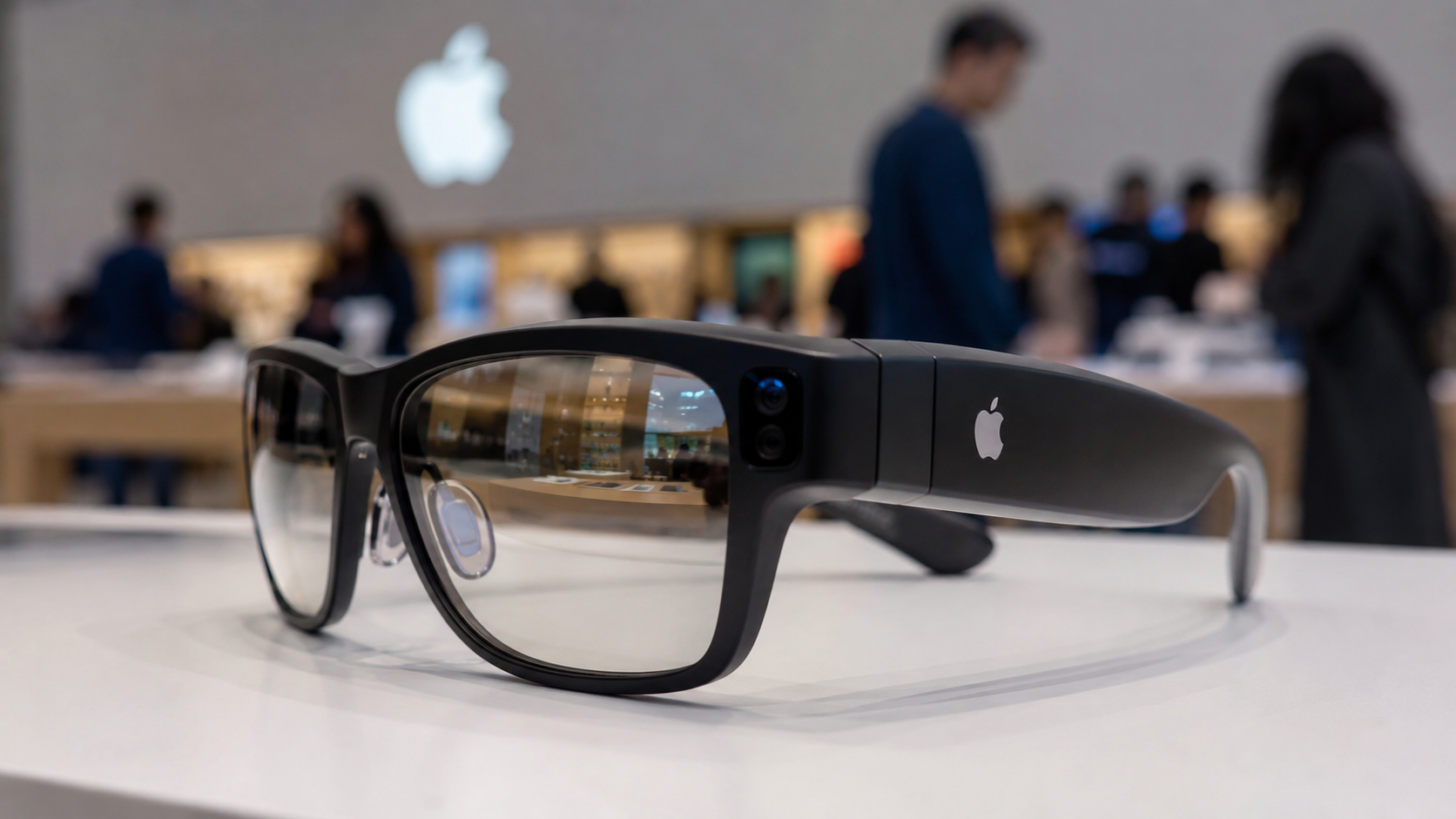
Apple is reportedly preparing to enter the smart-glasses market. But the company’s biggest challenge may have little to do with battery life, design or artificial intelligence.
It is privacy.
Recent reporting suggests Apple is exploring smart glasses that could be introduced in the future. Apple has not officially announced the product, and its design, features and release schedule could still change.
What makes the development interesting is Apple’s apparent attempt to treat privacy as a core product decision rather than something added after launch.
The company is reportedly considering stronger on-device processing, avoiding facial recognition and placing tighter limits on how recordings and environmental data are handled.
That approach could help Apple distinguish its glasses from competing products.
But it does not completely solve the most difficult problem facing camera-equipped wearables:
The person wearing the glasses may have accepted the privacy terms. Everyone around that person has not.
People can usually recognise when someone is recording with a smartphone.
The phone comes out of a pocket, is raised and is pointed towards a person or scene. Even without a warning, people nearby can generally understand what is happening.
Smart glasses remove much of that visible behaviour.
A camera can sit quietly beside the wearer’s eyes and capture almost exactly what the person sees. Microphones can hear surrounding conversations, while artificial intelligence could potentially interpret signs, objects, locations and events in real time.
From a distance, the device may look like an ordinary pair of glasses.
A small indicator light might show that recording is active, but someone standing several metres away may not notice it. Even when they do, they may not know whether the glasses are:
This uncertainty changes the relationship between the wearer and everyone nearby.
Privacy is no longer only about where information is stored. It also becomes a question of whether people know that the device is observing or analysing them at all.
Apple is reportedly considering how much camera functionality its smart glasses should provide.
A conventional camera would allow users to capture photographs and videos without taking out a phone. It could also support useful features such as visual search, translation, navigation and hands-free assistance.
Another possibility would be to use the camera mainly as a sensor for artificial intelligence.
In that model, the glasses could understand what the wearer is looking at and answer questions about the surrounding environment without necessarily behaving like a conventional recording device.
A camera-free version would create fewer privacy concerns, but it would also remove many of the capabilities that make smart glasses attractive.
That leaves Apple with a difficult trade-off.
The more capable the camera becomes, the more useful the product may be to the wearer. But those same capabilities increase the risk of non-consensual recording, surveillance and misuse.
Apple is therefore not making only a hardware decision.
It is deciding what the device should be allowed to see, understand, store and remember.
Processing audio, video and AI requests directly on the device would be a meaningful privacy safeguard.
It could reduce the amount of sensitive information sent to external servers. It may also limit the damage caused by a compromised cloud account or excessive data retention.
For example, if the glasses can recognise an object or translate a sign locally, the captured information may not need to be uploaded and stored elsewhere.
That would be better than sending every interaction to the cloud.
But local processing does not eliminate the concern of the person standing in front of the glasses.
A bystander may still be uncomfortable knowing that a device is analysing their face, voice, clothing, workplace badge or surroundings—even when the information never leaves the wearer’s device.
This distinction matters.
Data security asks whether information is protected after it has been collected.
Privacy also asks whether that information should have been collected or interpreted in the first place.
A device can be technically secure and still make people feel constantly observed.
Apple is reportedly unlikely to include facial recognition in its first smart glasses.
That would be an important limitation.
Facial recognition could allow wearers to identify strangers without their knowledge. It could also enable unwanted tracking and create serious risks involving:
Even a feature created for an innocent purpose could be misused.
A tool designed to help someone remember a colleague’s name could eventually be connected to social-media accounts, data brokers or commercially available personal information.
Once that capability exists, controlling every future use becomes extremely difficult.
Avoiding facial recognition would therefore be more than a marketing choice. It would establish an important boundary around what wearable artificial intelligence should be permitted to do.
Smart glasses could provide genuine value inside organisations.
In manufacturing, an engineer could see hands-free repair instructions while working on equipment.
In logistics, a warehouse employee could receive inventory information without checking a handheld device.
In healthcare, a professional might access relevant information while keeping both hands available.
In field service, a technician could share a first-person view with a remote expert.
These are practical use cases.
But the same device could also capture information that an organisation has a legal and operational responsibility to protect.
That could include:
Organisations may eventually need specific policies for AI glasses, just as they already maintain policies for smartphones, removable storage and personal laptops.
Security teams may need controls that can:
In regulated environments, relying only on the wearer’s judgement may not be sufficient.
A person may have no malicious intention and still accidentally expose confidential information.
Camera-equipped smart glasses commonly use a small light to indicate when recording is active.
That is useful, but it is not a complete privacy control.
The indicator may be difficult to see in bright conditions. People may not understand what it means. A dishonest user may also attempt to cover, modify or disable it.
A more trustworthy design would enforce the indicator at the hardware level.
Applications should not be able to switch it off. Software updates should not be able to weaken it quietly. Recording should stop if the indicator is obstructed or damaged.
Apple could also consider safeguards such as:
The strongest privacy controls are those that neither the wearer nor an application can secretly bypass.
Manufacturers often design privacy controls around the assumption that most users will behave responsibly.
That may be true, but responsible users are not the only concern.
A wearable device could be misused intentionally. It could also be compromised through a malicious application, a stolen account or a future software vulnerability.
The risk is not limited to someone secretly recording a stranger.
Attackers could potentially target smart glasses because of the unusually sensitive information they may collect.
Depending on their capabilities, compromised glasses could expose:
This is why smart-glasses security cannot stop at protecting the owner’s account.
The device must also protect the people and environments appearing in front of it.
Apple has spent years presenting privacy as one of the reasons customers should trust its products.
That gives the company an advantage in the smart-glasses market.
Some consumers may be more willing to wear an Apple device than a product from a company strongly associated with advertising and large-scale behavioural-data collection.
But that reputation also creates greater risk.
A privacy failure involving a smartphone is serious. A privacy failure involving a device worn on someone’s face could feel far more invasive.
Apple will therefore need to earn the confidence of two different groups:
Winning only the first group will not be enough.
A product can succeed commercially while still creating widespread discomfort among people who never chose to use it.
Smart glasses could also create difficult questions for governments and regulators.
Existing privacy laws were largely developed around websites, mobile applications, databases and conventional surveillance systems.
Wearable AI combines several technologies at once:
That combination may not fit neatly into existing rules.
Regulators may eventually need to clarify:
The technology may develop faster than the legal framework around it.
That makes the decisions taken by Apple and other manufacturers especially important. Product design could establish real-world standards before regulation catches up.
Apple’s reported privacy-focused direction is encouraging.
On-device processing, the possible absence of facial recognition and tighter controls over recordings could place meaningful boundaries around the technology.
But the success of smart glasses should not be measured only by how securely they store information.
It should also be measured by how clearly people can understand when they are being recorded or analysed.
Wearable AI introduces a problem that privacy policies and setup screens cannot solve on their own.
Bystanders do not participate in the device setup. They do not accept its terms. Yet they may become part of the information it processes.
For smart glasses to become socially acceptable, manufacturers must treat those bystanders as stakeholders rather than background data.
Apple has an opportunity to establish a higher standard for the industry.
The most important feature of its smart glasses may not be what they can do.
It may be what Apple deliberately prevents them from doing.
This article is based on recent reporting about Apple’s reported smart-glasses development and its possible privacy-focused approach.
Apple has not officially announced the product. Its features, design and expected release schedule may change before any commercial launch.
Reported product details and RootToHack’s independent analysis have been presented separately so that speculation and reporting are not confused with confirmed Apple announcements.