Physical Address
Bangalore, Karnataka, India
Physical Address
Bangalore, Karnataka, India

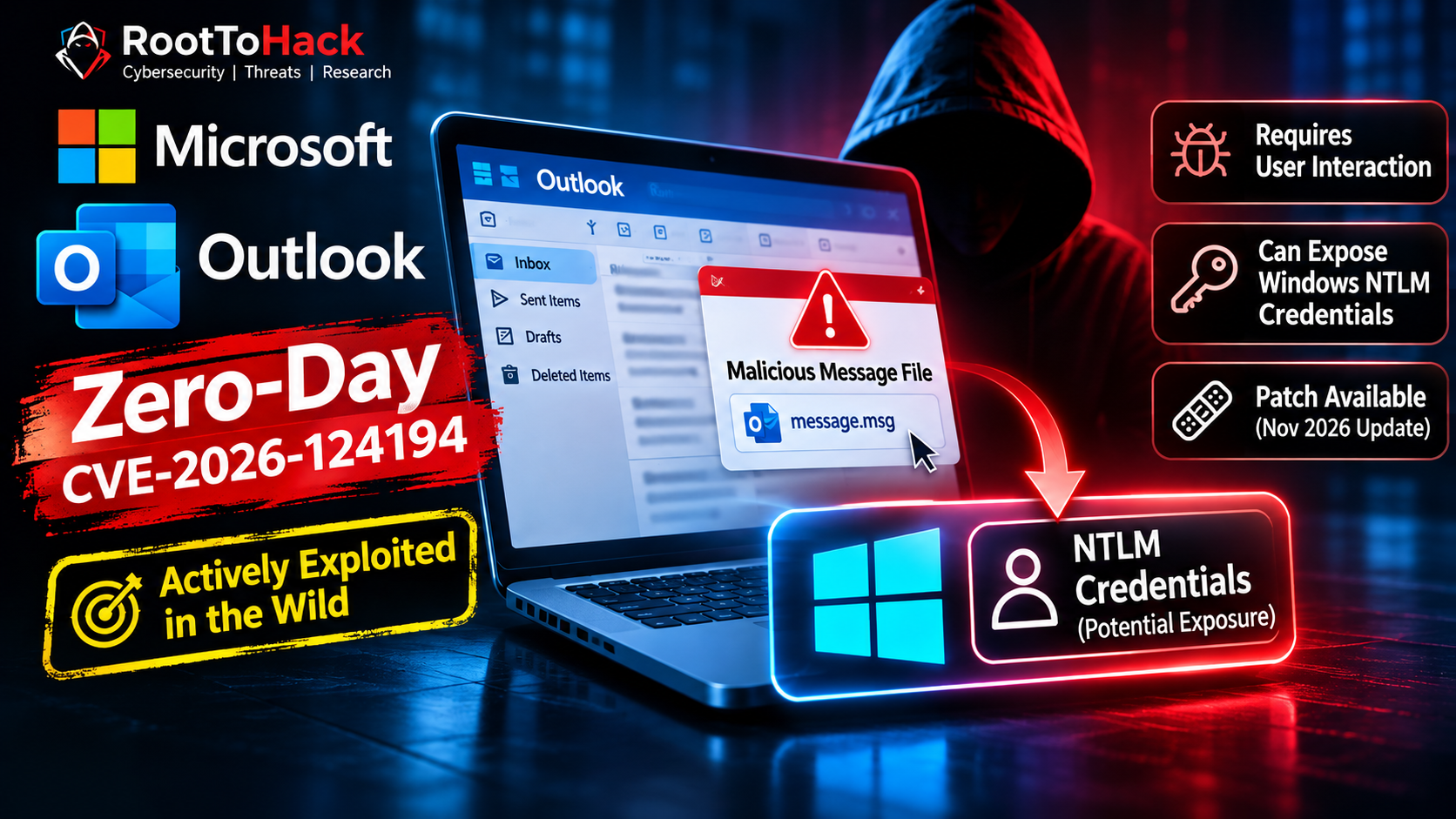
Microsoft has released security updates addressing an actively exploited zero-day vulnerability in Outlook that could allow attackers to steal Windows authentication information and potentially impersonate affected users.
The vulnerability, tracked as CVE-2026-124194, was fixed as part of Microsoft’s November 2026 Patch Tuesday updates released on November 10. It affects supported versions of Microsoft Outlook and can be exploited by convincing a user to open a specially crafted message file.
Although Microsoft has classified the issue as Moderate severity with a CVSS score of 6.5, the company confirmed that attackers had already exploited the vulnerability before a security fix became available.
The flaw is particularly concerning because successful exploitation can expose a user’s NTLMv2 authentication hash, potentially allowing attackers to use the captured authentication material in subsequent attacks.
Microsoft has not disclosed details about the attacks observed in the wild, including the identities of the threat actors, the organizations targeted, or the scale of exploitation.
The vulnerability stems from Outlook failing to display an appropriate security warning before performing an unsafe action involving external network content.
An attacker can prepare a malicious message file containing a reference to an attacker-controlled network location and deliver it to a potential victim.
If the user opens the crafted file in a vulnerable version of Outlook, the application may attempt to connect to the external location without displaying the usual warning.
During that connection, Windows may automatically negotiate NTLM authentication, potentially exposing the user’s NTLMv2 authentication hash to the remote system.
This authentication information could then be used in certain circumstances to impersonate the user, including through credential relay attacks or attempts to recover a password from captured authentication material.
The vulnerability does not mean an attacker immediately obtains the user’s plaintext password. However, exposing NTLM authentication material can create opportunities for further compromise, particularly in environments where NTLM authentication remains widely enabled.
Microsoft confirmed that exploitation requires user interaction and network connectivity. The victim must be persuaded to open the malicious file, meaning simply receiving an email is not sufficient to trigger the vulnerability.
The company also clarified that Outlook’s Preview Pane is not an attack vector for CVE-2026-124194.
This distinction matters because some Office vulnerabilities can be exploited through document previews without requiring users to open a malicious file. In this case, the attacker must successfully induce the additional user action.
Microsoft marked CVE-2026-124194 as exploited in the wild when publishing its November security updates.
However, the company has not released technical details about the attacks or identified the threat actors involved.
There is currently no confirmed public information establishing whether the exploitation was associated with a particular phishing campaign, targeted intrusion, or broader criminal operation.
The vulnerability was also not publicly disclosed before Microsoft’s security update became available.
Microsoft credited security researchers using the names nono and Benoît Sevens for reporting the issue. The advisory’s acknowledgment for Sevens also referenced the use of Anthropic’s Claude AI model.
The involvement of an AI-assisted research workflow in the discovery is noteworthy, although Microsoft’s acknowledgment does not establish that AI independently discovered or exploited the vulnerability.
The combination of confirmed exploitation and limited information about the observed attacks makes the issue an important priority for organizations running affected Outlook versions.
Microsoft’s advisory identifies affected products including Microsoft 365 Apps for Enterprise, Office LTSC 2021, and Office LTSC 2024.
Organizations should consult the official vulnerability advisory to determine which product builds and update packages apply to their specific deployments.
Not every Outlook product or version should be assumed vulnerable solely because it shares the Outlook name.
For enterprise administrators, identifying the affected installation types is particularly important in environments where Microsoft 365 Apps and perpetual Office installations are deployed alongside one another.
Security teams should also distinguish this Outlook vulnerability from other Office flaws addressed in the same monthly release. The availability of updates for one Office component does not automatically establish that every vulnerable application has been remediated.
NTLM is a Windows authentication protocol that remains present in many enterprise environments, particularly where legacy applications, file-sharing systems, and older authentication configurations are still in use.
When a Windows system connects to a remote resource, it may attempt to authenticate using the current user’s credentials.
If that connection is directed to infrastructure controlled by an attacker, the authentication exchange can expose information that may be useful in subsequent attacks.
Depending on the environment and available protections, attackers may attempt to relay NTLM authentication to another service or carry out offline password-guessing attacks against captured challenge-response material.
The success of these techniques depends on additional factors, including service configuration, authentication protections, and the strength of the user’s password.
For organizations, the potential consequences can extend beyond the individual Outlook application.
A compromised identity may provide access to internal file shares, applications, or other resources if additional exploitation conditions are met.
This is why vulnerabilities involving authentication disclosure deserve careful consideration even when their initial severity ratings appear relatively low.
The Outlook zero-day was released alongside a substantial collection of security updates affecting Windows, Microsoft Office, Active Directory, Exchange Server, and other Microsoft technologies.
Among the vulnerabilities addressed were critical remote code execution and privilege escalation issues affecting enterprise systems.
Several flaws involved components widely deployed across corporate networks, making patch management particularly important for organizations running large Windows environments.
Unlike the Outlook vulnerability, the other issues highlighted in the November release were not identified by Microsoft as actively exploited at the time of publication.
This distinction should guide remediation priorities.
While critical severity vulnerabilities can present serious risks, confirmed exploitation provides additional evidence that attackers are already using a particular weakness.
Organizations should therefore consider both technical severity and known exploitation activity when determining which updates require immediate attention.
Organizations using affected versions of Outlook should deploy Microsoft’s November 2026 security updates as soon as operationally practical.
IT administrators should verify the applicable updates through Microsoft’s Security Update Guide and confirm successful installation across managed endpoints.
Security teams should also investigate unexpected outbound authentication attempts to unfamiliar external systems, particularly those associated with Outlook activity.
Where available, endpoint detection and network monitoring tools can help identify suspicious connections involving SMB or other protocols capable of carrying NTLM authentication.
Restricting unnecessary outbound SMB traffic to untrusted networks can reduce opportunities for external credential exposure.
Organizations should also review their reliance on NTLM authentication and consider stronger authentication mechanisms where supported.
However, disabling NTLM across an enterprise without assessing application dependencies can disrupt legitimate services. Any migration should be planned and tested carefully.
Users should be cautious when opening unexpected Outlook message files or attachments, especially those received through unsolicited emails.
These defensive measures can reduce exposure, but they should not be treated as substitutes for installing the security update.
CVE-2026-124194 demonstrates why vulnerability severity scores should not be the only factor considered during security patching.
Although the issue carries a Moderate rating, Microsoft has confirmed exploitation, and the vulnerability affects authentication information that could be valuable to attackers.
The absence of publicly disclosed attack details also means organizations cannot rely on a known campaign profile to determine whether their environments are at risk.
For security teams, the immediate priority is to identify vulnerable Outlook deployments, apply the relevant updates, and review potentially suspicious authentication activity.
The incident also reinforces an established Windows security concern: applications that initiate connections to untrusted external resources can expose authentication material when appropriate safeguards are missing.
With a fix now available, organizations have a clear remediation path, but delaying the update could leave vulnerable systems exposed to an attack technique that has already been used in the wild.