Physical Address
Bangalore, Karnataka, India
Physical Address
Bangalore, Karnataka, India

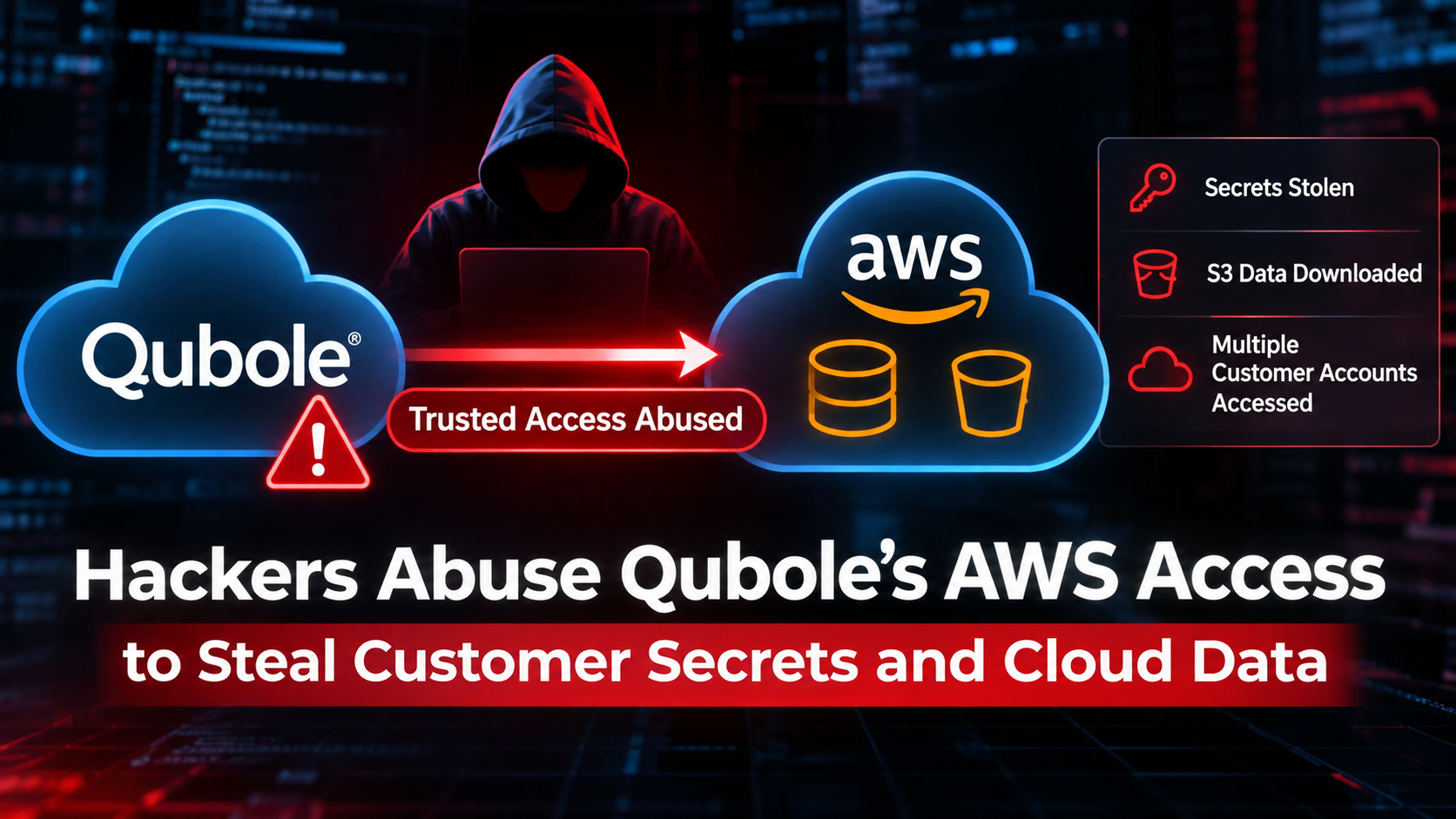
Attackers have abused trusted AWS access associated with cloud data platform Qubole to infiltrate multiple customer environments, steal sensitive credentials, and download data from Amazon S3 buckets.
The campaign, observed between October 14 and October 26, 2026, involved IAM credentials associated with a Qubole-operated AWS account. According to an investigation published by cloud security firm Wiz on November 9, the attackers exploited existing cross-account trust relationships to access customer resources without compromising individual AWS accounts directly.
The activity was uncovered through a joint investigation involving Wiz, Sentra, and Mandiant. Researchers found that the attackers were able to move across multiple customer environments using permissions originally granted to Qubole for legitimate cloud operations.
The findings highlight a broader security concern for organizations relying on third-party cloud integration’s, where access granted to external services can become an entry point if trusted credentials are compromised.
Qubole uses AWS Identity and Access Management (IAM) roles to access customer cloud resources. These roles establish a trust relationship that allows authorized identities from Qubole’s AWS account to assume temporary permissions within customer environments.
The attackers obtained credentials associated with AWS account 805246085872, which was linked to Qubole, and used AWS Security Token Service (STS) AssumeRole requests to access customer integration roles.
The requests contained the required External IDs, allowing them to satisfy the conditions configured in customer IAM trust policies.
External IDs are designed to help prevent the confused deputy problem, in which a third party could be tricked into accessing resources on behalf of an unauthorized customer. However, they are not secret authentication credentials and cannot independently protect an integration when an already trusted identity is compromised.
Wiz first observed suspicious activity on October 14, when the attacker initiated role-assumption requests from an IP address associated with Mullvad VPN. Subsequent activity originated primarily from an OVH-hosted server.
On October 18, researchers observed the use of another IAM identity associated with the same Qubole-linked AWS account, expanding the suspicious activity across customer environments.
The investigation has not established how the attackers initially obtained the credentials or identified the threat actor responsible for the campaign.
One of the most significant findings was that several affected organizations still maintained Qubole integration roles despite little or no recent legitimate activity.
According to Wiz, in most of the observed environments, the attacker’s requests were the only role-assumption activity associated with the Qubole account during October.
These trust relationships remained active even though the integration’s were no longer being regularly used.
As a result, the attackers could assume roles that organizations may not have considered part of their current cloud operations.
The incident highlights an often-overlooked cloud security issue: removing an application or discontinuing a service does not necessarily revoke the IAM permissions previously granted to it.
Unless unused roles and trust relationships are explicitly removed, they can remain available to identities authorized under the original configuration.
After obtaining temporary AWS credentials, the attackers began enumerating resources within the affected environments.
Researchers observed API calls targeting EC2 instances, IAM roles, RDS databases, S3 buckets, and other services to identify accessible infrastructure and data.
The activity extended to services that frequently contain sensitive application credentials.
The attackers queried AWS Secrets Manager using ListSecrets and GetSecretValue, accessed Systems Manager Parameter Store through DescribeParameters and GetParameter, and inspected AWS Lambda environment variables using GetFunctionConfiguration.
They also used TruffleHog, a legitimate secret-discovery tool, to identify and validate credentials found during the intrusion.
Wiz reported attempts to validate AWS credentials through GetCallerIdentity, authenticate using Microsoft Entra ID service principal credentials, and obtain OAuth tokens from Okta.
These activities indicate that the attackers were not exclusively interested in AWS data. They were also examining whether stolen credentials could provide access to additional enterprise services.
However, the investigation does not establish that every credential tested resulted in successful unauthorized access.
Alongside credential collection, the attackers accessed data stored in Amazon S3.
The observed activity followed a recurring sequence involving ListBuckets, ListObjects, HeadObject, and GetObject requests.
These operations allowed the attackers to identify accessible buckets, inspect stored objects, and download data using permissions inherited from the assumed integration roles.
In some cases, entire S3 buckets were reportedly downloaded during a single session.
The investigation described the activity as opportunistic, with attackers targeting resources available through the compromised permissions rather than consistently pursuing one specific type of data.
Wiz did not publicly disclose the affected organizations or the total volume of stolen information.
Researchers identified several indicators that organizations can use to investigate potentially related AWS activity.
The campaign involved role assumptions associated with Qubole-linked AWS account 805246085872, including suspicious session names such as quiam-enum and quiam-scope-full.
Observed source IP addresses included:
57.129.54[.]12045.83.220[.]211185.209.199[.]7389.37.63[.]175Organizations should correlate these indicators with IAM role assumptions, session activity, timestamps, and subsequent API operations. IP address matches alone should not be treated as conclusive evidence of compromise, particularly when shared VPN infrastructure is involved.
Wiz recommended examining historical AWS activity beginning October 1, 2026, with particular attention to unexpected AssumeRole requests.
Security teams should also review suspicious access to Secrets Manager, Parameter Store, Lambda configurations, and S3 storage.
The investigation highlighted another challenge: S3 object-level data events are not recorded by CloudTrail by default.
Without the appropriate logging configuration, organizations may be able to identify suspicious role assumptions but lack sufficient evidence to determine precisely which objects were accessed or downloaded.
Organizations that currently use or previously integrated with Qubole should review IAM roles that trust the vendor’s AWS account and determine whether those integration’s remain necessary.
Unused trust relationships should be removed, while active integration’s should be restricted to the minimum permissions required for legitimate operations.
Security teams should investigate unusual role-assumption activity, unexpected access to secrets, and large or unfamiliar S3 downloads.
Where unauthorized activity is confirmed, organizations should assess potentially exposed credentials, rotate affected secrets, and consider revoking active IAM role sessions to prevent continued access through previously issued temporary credentials.
Enabling appropriate CloudTrail data-event logging for sensitive S3 buckets can also improve visibility during future investigations.
The Qubole campaign demonstrates how trusted third-party access can become a security risk across multiple customer environments when the underlying credentials are compromised.
For organizations operating in AWS, the incident reinforces the need to regularly review external IAM trust relationships, monitor vendor access, and remove permissions associated with integration’s that are no longer required.
Sources: Wiz Research — Qubole Cross-Account Access Abused in the Wild (November 9, 2026); AWS IAM Documentation.