Physical Address
Bangalore, Karnataka, India
Physical Address
Bangalore, Karnataka, India
Finding a serious software vulnerability once demanded weeks of patient work.
A researcher had to understand the product, inspect its behaviour, test several theories and prove that a weakness could cause real harm. Only then would a detailed report reach the vendor’s security team.
Generative AI is compressing that process.
Researchers can now use AI to study unfamiliar code, identify suspicious functions, generate test cases, interpret crashes and explore possible attack paths. In experienced hands, these tools can help uncover genuine vulnerabilities much faster.
However, they can also produce convincing mistakes.
That is the problem now confronting Apple.
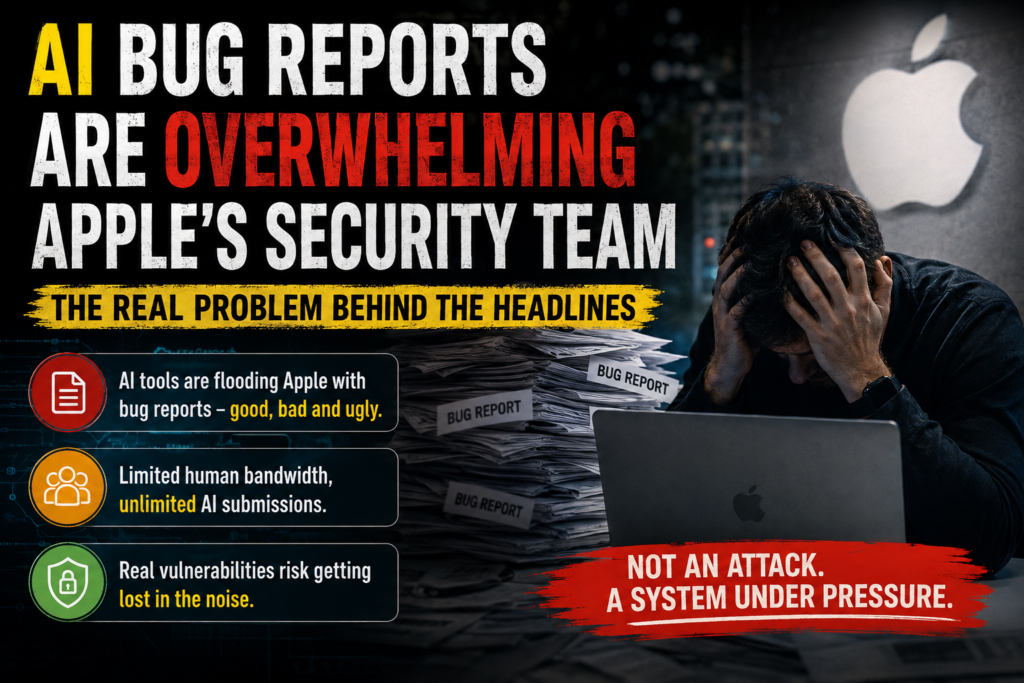
The company has restricted how many unresolved security reports researchers can keep open after receiving a growing volume of AI-assisted submissions. Some reports describe legitimate weaknesses. Others appear technically impressive but cannot be reproduced by Apple’s engineers.
This is not a story about Apple being hacked by artificial intelligence.
It is a story about a deeper shift inside cybersecurity: AI may soon generate possible vulnerabilities faster than security teams can verify, prioritise and fix them.
Apple told the Financial Times that it had placed limits on the number of new security reports an outside researcher could keep open at one time.
Researchers who reach the limit may face a 30-day cooling-off period before submitting more reports. However, Apple says they can request additional capacity when they have important findings to disclose.
At first, this may look like a small operational change inside Apple’s bug-bounty programme.
It is not.
Bug-bounty systems were created during a period when discovery was the main bottleneck. Vendors wanted more qualified researchers to examine their software because serious vulnerabilities could remain hidden for years.
AI is beginning to reverse that assumption.
The difficult question may no longer be, “Can someone find the flaw?”
It may become, “Can the vendor determine which of these hundreds of possible flaws is real?”
Every report must still be reviewed. Someone must reproduce the behaviour, confirm the affected version, examine the attacker’s required access and determine whether the claimed impact is technically possible.
That work remains slow, expensive and deeply human.
The distinction matters.
Apple is not saying that researchers must avoid AI tools. Its own security programme recognises that automated systems can contribute to legitimate vulnerability research.
What Apple is pushing back against is the submission of theoretical or AI-generated findings that have not been properly validated.
Apple’s Security Bounty Guidelines state that repeated submission of ineligible reports—including theoretical issues or findings discovered by AI without sufficient validation—may result in report processing being paused for 180 days. Researchers who enter paused status more than twice may be removed permanently from the programme.
The meaning is straightforward.
A researcher can use AI to form a hypothesis.
But the model’s answer cannot be treated as proof.
The researcher still needs to demonstrate what happens, where it happens, which product versions are affected and why the behaviour creates a meaningful security risk.
Using AI is not the problem.
Submitting untested AI output as a confirmed vulnerability is the problem.
It would be easy to describe this entire issue as an “AI slop” problem.
That would be misleading.
The same tools generating poor-quality reports are also helping experienced researchers discover genuine vulnerabilities.
The Financial Times reported that Italian cybersecurity company Bynario used ChatGPT while identifying more than 50 potential macOS issues over roughly three weeks. Apple said it was communicating with the company and reviewing its submissions.
Apple’s own security material also shows that automated discovery systems are contributing to real security fixes.
The company’s macOS Tahoe 26.6 advisory credits automated vulnerability-discovery technology alongside human researchers for CVE-2026-43760. Apple said the Screen Sharing Server flaw could allow an application to access sensitive user data and that the issue was fixed through stronger access restrictions.
This is why vendors cannot simply ignore reports that mention AI.
A machine-assisted report may be incorrect.
It may also reveal a vulnerability affecting millions of devices.
Both can arrive through the same portal. Both can be written in polished technical language. Both can contain references to functions, permissions and possible exploit paths.
Only one may survive proper testing.
The evidence supports a clear but limited conclusion.
Apple has confirmed that it restricted the number of open security submissions while dealing with increased report volume linked to AI-assisted vulnerability research. Its official guidelines also confirm that repeated, improperly validated AI findings can lead to reporting restrictions.
There is also confirmed evidence that automated security tools have contributed to vulnerabilities that Apple later patched.
However, this is not evidence of active exploitation.
There is no confirmed public indication that attackers exploited Apple’s reporting backlog. There is also no proof that the submission limits directly caused a known vulnerability to remain exposed.
Bynario reportedly described an unpublished privilege-escalation chain that it could not immediately submit after reaching Apple’s limit. Yet the technical details have not been published in enough depth for independent verification. Claims about its value on criminal markets are estimates, not confirmed transactions.
So the correct evidence classification is:
Confirmed operational concern, with several related vulnerability claims still awaiting independent validation.
The issue deserves attention, but it should not be presented as an Apple breach or an actively exploited security emergency.
An AI model does not usually examine an application and produce a perfect exploit on its first attempt.
The real workflow is more complex.
A researcher may begin with source code, application behaviour, crash output, binaries or a recent patch. The AI tool can then help explain unfamiliar logic, identify suspicious data flows or propose places where access-control checks may fail.
A typical process looks like this:
Source code or application behaviour
→ AI-assisted analysis
→ Possible weakness identified
→ Researcher builds a test case
→ The behaviour is reproduced
→ Security impact is confirmed
→ The vendor receives the report
→ The flaw is patched and retested
AI can speed up several parts of this process.
It can:
Yet AI models do not automatically understand every operating-system protection, permission boundary or runtime condition.
A model may analyse code that is never reachable.
It may assume an attacker has privileges they do not possess.
It may describe a function that exists in a different version.
It may overlook sandboxing, code signing, memory protections or authentication checks that block the proposed attack.
The generated explanation may sound excellent.
The vulnerability may still not exist.
The central problem is not simply that AI can make mistakes.
Security scanners have produced false positives for decades.
The bigger change is the cost of producing those mistakes.
A researcher can now generate a detailed vulnerability report in minutes. The report may contain code examples, attack scenarios, severity estimates and professional technical language.
Apple’s security engineers may then spend hours proving that one assumption inside the report is wrong.
That creates an uneven workflow:
AI generates a possible finding
→ A researcher submits it
→ The vendor assigns an analyst
→ The analyst attempts reproduction
→ The code and permissions are reviewed
→ The report is accepted, rejected or marked as duplicate
AI makes the first two stages faster.
The vendor still pays the cost of everything that follows.
If thousands of people use AI to submit loosely tested findings, vendors may spend more time disproving vulnerabilities than fixing real ones.
The underlying trust assumption has changed.
Traditional disclosure systems assumed that writing a detailed vulnerability report required enough effort to discourage unlimited speculation.
Generative AI has reduced that effort dramatically.
Low-quality submissions are not the only concern.
The greater risk is that a legitimate vulnerability may wait behind hundreds of inaccurate reports.
A critical weakness does not become less dangerous because several unverified findings entered the queue before it.
If reviewers are overloaded, the response slows for everyone:
The problem is especially difficult because sophisticated AI-generated reports may look more credible than shorter human-written reports.
A genuine researcher may submit a concise description with clear reproduction steps. Another submitter may provide 20 pages of polished AI-generated analysis with no working proof.
Security teams must avoid confusing length with quality.
Evidence matters more than presentation.
Apple has the resources to employ experienced security engineers, operate a major bounty programme and build internal triage systems.
Smaller organisations may face a much harder problem.
Open-source maintainers are particularly exposed. A widely used project may be maintained by a small group of developers who already work in their spare time. A sudden influx of AI-generated vulnerability reports can consume the same limited attention required for development, maintenance and patching.
This wider strain is already visible across the bug-bounty ecosystem. Other programmes and open-source projects have also reported increased volumes of low-quality AI-generated findings, forcing maintainers to rethink how submissions are accepted and reviewed.
Bug-bounty platforms face the same pressure. They must identify duplicates, score report quality and protect vendors from noise without creating barriers that prevent new researchers from participating.
Inside enterprises, the problem may be even less visible.
Application-security teams already receive findings from:
If AI-generated findings enter those systems without clear validation states, vulnerability backlogs may grow rapidly while actual security understanding gets worse.
The Apple story exposes a structural weakness inside modern vulnerability management.
Most organisations measure how many findings they have discovered.
Far fewer measure how confidently those findings have been validated.
That difference matters.
A technically convincing report can take hours to investigate.
The analyst may need to rebuild an environment, examine application logs, review source code, trace permissions and reproduce the exact conditions described.
If the report is invalid, that time cannot be recovered.
A large increase in weak findings can therefore reduce the number of real vulnerabilities the team has time to fix.
An AI tool that reports 10,000 possible vulnerabilities may appear more effective than one that finds 20 confirmed weaknesses.
However, raw finding volume says little about actual security value.
The important questions are:
Without those measures, an organisation may mistake activity for risk reduction.
Generative AI is exceptionally good at producing authoritative language.
A report may confidently describe APIs, functions, privileges and attack stages while relying on one false assumption that invalidates the entire result.
Reviewers should therefore judge the evidence, not the fluency of the report.
AI-assisted analysis is available to defenders and attackers.
Once a vendor releases a security update, researchers can compare the patched and unpatched code to understand what changed. AI can help explain that difference and suggest how the original vulnerability worked.
This may shorten the time between patch release and attacker exploitation.
The organisation’s ability to validate, prioritise and deploy fixes quickly will matter even more.
Apple’s public guidance focuses on reproducibility and evidence.
Researchers are expected to provide enough information for Apple to understand the issue, reproduce the behaviour and assess its impact. Repeated submission of theoretical or improperly validated AI-discovered vulnerabilities may result in a 180-day reporting pause.
That principle should extend beyond Apple.
A credible AI-assisted report should identify:
AI-generated reasoning may support the report.
It should not replace observable evidence.
The security industry has dealt with false positives for years.
What makes this moment different is scale.
Traditional scanners usually operate within a defined environment. They produce findings based on known signatures, rules or code patterns. Their weaknesses are familiar, and their output volume is somewhat predictable.
Generative AI removes many of those boundaries.
A person with limited security experience can now ask a model to inspect code, suggest vulnerabilities and generate professional reports. Automated agents may eventually repeat that process across thousands of repositories without waiting for a human to submit each result.
That changes the economics of disclosure.
The cost of generating a possible vulnerability is collapsing.
The cost of proving it remains high.
Apple’s limits may protect its security team in the short term. Still, quotas are a blunt control.
A flat report limit can slow down both poor-quality submitters and highly capable researchers who have uncovered several genuine vulnerabilities. Vendors will eventually need something more intelligent than simply restricting volume.
The stronger approach is evidence-weighted intake.
Reports with stable reproduction steps, logs, crash data, affected versions and working proofs should move faster.
Reports containing only model-generated explanations should remain in a lower-confidence state until the submitter provides stronger evidence.
Organisations should stop treating every security observation as a confirmed vulnerability.
A better workflow would classify findings into stages such as:
This distinction prevents one of the most dangerous reporting errors.
A model-generated hypothesis should not appear on an executive dashboard as a confirmed critical vulnerability.
The status must reflect the available evidence.
That may sound obvious, but many vulnerability-management platforms were designed before AI tools began generating findings at scale. Their workflows often move reports too quickly from discovery into formal risk registers.
The process now needs to change.
Apple is also reportedly using AI to help process the growing volume of submissions.
That is a sensible use case.
AI can help:
However, vendors should be careful about allowing AI to reject unusual findings automatically.
A triage model may dismiss a novel attack for the same reason a discovery model may invent one: it lacks complete context.
Research examining the use of language models for bug-bounty review has also found that models can struggle to identify invalid reports consistently and may lean toward accepting questionable findings.
One model agreeing with another is not independent verification.
AI can organise the queue.
It should not quietly become the final authority on whether an unknown vulnerability exists.
AI-generated discoveries should enter a dedicated validation stage.
They should not automatically be added to the main vulnerability backlog, executive dashboard or regulatory report.
Only reproduced findings should progress to confirmed status.
A report should receive higher priority when it contains:
Report length should not influence priority.
Evidence should.
Vendors need a controlled path for researchers who believe they have found a severe vulnerability but have reached a submission limit.
This channel may be reserved for issues such as:
Abuse should carry consequences. Yet the path must remain available.
Historical report quality can help with prioritisation.
Researchers who consistently submit reproducible findings may deserve faster review or higher submission limits.
However, reputation should never become an absolute gate. New researchers may discover important vulnerabilities, while experienced researchers can still make mistakes.
Reputation should influence triage, not replace evidence.
AI may be valuable for grouping reports that share:
Human reviewers should confirm technically important merges. Textual similarity alone is not enough because different vulnerabilities may produce similar descriptions.
A vulnerability-discovery tool may need source code, test environments and build logs.
It does not automatically need production credentials, customer data or unrestricted access to every repository.
Use a dedicated identity. Apply least privilege. Keep exploit testing inside a sandbox. Require approval before the tool executes potentially destructive actions.
AI-assisted vulnerability research creates a new evidence trail.
Organisations should record:
These records may contain source code, exploit details, credentials and sensitive architecture information.
Access must therefore be restricted. Retention should be long enough to support incident investigation and the later reassessment of rejected findings.
AI activity should also be correlated with:
A finding dismissed today may become relevant later when a related vulnerability is discovered.
Without an investigation trail, the organisation may not be able to reconstruct why the original decision was made.
A sharp rise in submissions from one researcher, account or automated tool may indicate bulk AI generation.
Security teams should compare the volume with the researcher’s previous behaviour, report acceptance rate and level of supporting evidence.
However, volume alone is not proof of poor quality. A legitimate audit may produce several real findings at once.
Long reports that lack stable test steps, logs or observable output may deserve additional scrutiny.
Still, some vulnerabilities—particularly race conditions or hardware-dependent flaws—can be difficult to reproduce. Automated controls should not reject them without review.
A burst of reports involving the same component, stack trace or code location may represent duplicates generated from one underlying weakness.
Reviewers should confirm whether the technical root cause is genuinely the same before merging them.
Security teams should monitor whether an AI analysis tool reads code outside its authorised assessment scope.
Cross-repository access may be legitimate when shared libraries are involved. Therefore, context and ownership must be considered before treating the event as suspicious.
Inventory every AI tool involved in:
Identify the owner, model provider, data sources, repository access and external services involved.
Define the evidence required before a finding becomes official.
Apply dedicated identities, least privilege, sandboxing and approval controls. Prevent production secrets from entering model prompts unless there is a justified and controlled reason.
Send AI activity, repository access, validation attempts and reviewer decisions into the organisation’s logging or security-monitoring platform.
Correlate them with application, cloud, identity and endpoint telemetry.
Measure:
A security tool should be evaluated on risk reduction, not output volume.
Create procedures for:
AI-assisted security systems can fail in both directions.
They may invent vulnerabilities.
They may also miss or incorrectly reject real ones.
Start with one non-critical application.
Require a developer or security engineer to reproduce every finding before it enters the backlog. Avoid connecting autonomous tools to all repositories at once.
Measure the time saved per confirmed vulnerability.
Maintain a separate validation status for AI findings inside the existing vulnerability-management platform.
Assign clear ownership between application security, engineering and platform teams. Otherwise, AI findings will simply create another unowned queue.
Build an evidence-scoring layer that combines:
Large organisations may use separate models for discovery and triage, but deterministic evidence and human review should still carry more weight than model agreement.
Prompts, source code, vulnerability descriptions and model responses may contain regulated or confidential data.
Security teams must understand where the AI provider processes that information, how long it is retained and whether customer content is used for training.
An automated security agent that can inspect code, execute tests, open tickets and interact with cloud systems should be treated as a privileged non-human identity.
It needs scoped permissions, complete logs, action limits and a reliable method to stop or roll back unsafe behaviour.
AI vulnerability discovery should be built as an evidence pipeline, not a finding factory.
The model can suggest a weakness.
A controlled test must reproduce it.
A reviewer must confirm the impact.
The organisation must prioritise, fix and retest the issue.
If any of those stages are skipped, the result may look impressive on a dashboard while adding very little real security.
Apple’s experience is an early warning.
Soon, almost every security team and developer may have access to tools that can search for software weaknesses continuously. The winners will not be the organisations generating the largest number of reports.
They will be the organisations that can identify which reports deserve to be trusted.
Apple has not disclosed how many AI-assisted reports it now receives.
It has not revealed what percentage of those reports are valid, how many are duplicates or how much analyst time is being consumed.
The exact impact of the new limits on legitimate researchers is also unclear.
Bynario’s reported privilege-escalation chain has not been independently reproduced in public. Its full prerequisites, affected scope and exploitability remain unknown. There is no confirmed evidence that attackers used it.
Apple has not explained in detail how its internal AI triage process scores, prioritises or rejects submissions.
Those gaps matter.
Until more evidence appears, this story should not be framed as a breach, an active attack or proof that Apple’s security programme has failed.
It is something more structural.
It is an early sign that vulnerability discovery is beginning to move faster than the systems built to receive, verify and remediate it.
AI can now help generate a vulnerability report in minutes.
Proving that the vulnerability is real may still take hours or days.
That gap between machine-speed discovery and human-speed verification is becoming one of cybersecurity’s most important operational problems.
The future of vulnerability management will not depend only on finding more flaws.
It will depend on building enough evidence, context and trust to identify the findings that truly matter.