Physical Address
Bangalore, Karnataka, India
Physical Address
Bangalore, Karnataka, India

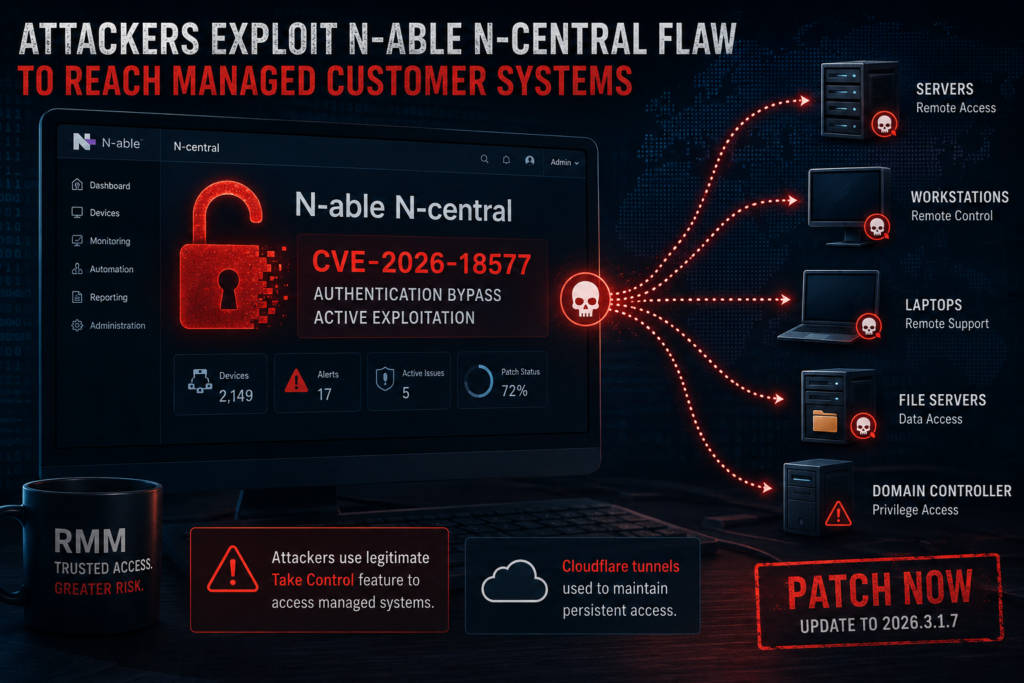
A dangerous flaw in N-able N-central is giving attackers something far more valuable than access to a single server.
It is giving them the keys to systems managed through that server.
The vulnerability, tracked as CVE-2026-18577, allows an unauthenticated attacker to bypass normal login controls and gain administrative access to a vulnerable N-central installation. Once inside, attackers have been seen using the platform’s legitimate remote-support tools to connect to customer endpoints.
New findings show the activity is no longer limited to one isolated incident. Similar attacks have now been identified across multiple organisations.
There is no evidence yet of indiscriminate, internet-wide exploitation. But that offers little comfort to managed service providers still running an exposed server. A compromised N-central console can place every connected customer environment within reach.
The first warning did not look like a major security incident.
On 31 July, N-able noticed an unusual increase in licensing problems affecting customers running N-central on their own infrastructure. The volume was high enough to trigger a deeper investigation.
By 2 August, the company had identified an alternative method for exploiting an authentication weakness it believed had already been addressed.
The earlier flaw, CVE-2026-18556, was fixed in N-central 2026.2. However, the investigation found another route that could bypass authentication and expose the same powerful administrative functions.
That newly identified path was assigned CVE-2026-18577.
N-able released an emergency hotfix, build 2026.3.1.7, and urged customers to install it immediately. Every earlier N-central version is considered affected.
CISA has since added the vulnerability to its Known Exploited Vulnerabilities catalogue, confirming that the flaw is being used in real attacks.
N-central is built to give managed service providers centralised control over customer systems.
Technicians can monitor devices, deploy software, run commands and start remote-support sessions without travelling to the customer’s location. That makes the platform efficient. It also means the N-central server sits at the centre of an unusually large trust relationship.
The attackers turned that trust against the organisations using it.
After gaining administrative access, they used N-central’s Take Control feature to open remote sessions on systems inside managed environments.
Take Control is a legitimate support function. Customers expect it to be present, and security tools may not immediately treat its activity as suspicious.
That gives an intruder a significant advantage. Instead of installing an unfamiliar remote-access program and hoping it avoids detection, the attacker can operate through software that administrators have already approved.
The attack may therefore look less like an outsider breaking into the network and more like a technician carrying out routine support work.
Investigators found remote sessions associated with the name MSP Support, the default identity connected to certain N-central Take Control activity.
That name alone does not prove an attack. Legitimate support sessions may produce similar records.
The timing and surrounding behaviour are what matter.
A remote connection becomes far more suspicious when it appears outside normal support hours, targets a sensitive server, comes from an unfamiliar source or has no matching service ticket.
Windows Application Event IDs 4102, 8192 and 8193 were identified in one affected environment. Those records can help show when a Take Control connection started, which identity was displayed and when the session ended.
Additional logs may be available on managed Windows systems under:
C:\ProgramData\GetSupportService_N-Central\Logs\
Files matching BASupSrvc_*.log.gz may contain useful details about remote-support activity.
These files are part of normal N-central operation. Their presence is not evidence of compromise. Their timestamps become valuable only when they are compared with administrator activity, support records and other endpoint events.
The intrusion did not necessarily end when access to the N-central server was removed.
After reaching managed endpoints, attackers were observed registering Cloudflare tunnels as Windows services. These tunnels created outbound connections from the compromised system.
That detail changes the response considerably.
An organisation may patch the vulnerable N-central server and assume the immediate danger has passed. But if an attacker established persistence on a customer endpoint before the update was installed, closing the original vulnerability will not remove that access.
The management server may be secure while one or more downstream systems remain compromised.
This is why the incident cannot be handled as a routine patching exercise. Organisations need to investigate what happened before the hotfix was applied.
A newly created Cloudflared service, particularly on a server that has no business reason to run one, should receive immediate attention. The same applies to unexpected executables, unusual outbound connections and remote sessions involving critical systems.
N-able controls the update process for its hosted N-central environments. That allowed the company to move those systems rapidly toward the fixed release.
Self-hosted customers have to manage the upgrade themselves.
They must notice the advisory, identify the affected installation, evaluate compatibility, arrange downtime and apply the hotfix. Each step introduces delay, and attackers are already aware of the opportunity.
The latest available measurement found that approximately 28.6% of reachable self-hosted N-central servers within the observed customer and partner population remained unpatched.
Across hosted and self-hosted installations combined, the figure was around 13.6%.
Those percentages do not represent every N-central deployment worldwide. They describe only the servers visible within the measured population.
Even so, the gap between hosted and self-managed systems is difficult to ignore.
Attackers do not need every N-central server to remain vulnerable. They need only a small number of exposed consoles with access to valuable customer environments.
One successful compromise may open far more doors than the vulnerable-server count suggests.
Several IP addresses were linked to the first observed attacks.
Later analysis found that some were exit nodes belonging to commercial VPN services. This means the same address could potentially be used by an attacker and by unrelated legitimate customers.
Blocking those addresses may still provide temporary protection. It should not be mistaken for a complete investigation.
An IP match is most useful when it supports a wider pattern.
For example, a connection from a previously reported address becomes more meaningful when it is followed by an unexpected Take Control session, access to a domain controller or the creation of a Cloudflare tunnel service.
Without that context, teams risk treating a shared VPN address as proof of compromise.
The strongest conclusions will come from behaviour, not from a single network indicator.
N-able has said that a limited number of customers were affected and that those organisations were contacted directly.
It has not disclosed the number of compromised servers or the number of downstream endpoints accessed.
There is also no public confirmation that attackers stole data, deployed ransomware or reached every system managed by the affected consoles.
Those distinctions matter.
Administrative access creates the opportunity to steal credentials, move laterally, install malware or prepare a larger attack. It does not prove that every possible action occurred.
Still, the access already confirmed is serious.
A managed service provider may use one N-central deployment to administer systems belonging to many separate businesses. The direct victim may be the MSP, but the operational and security consequences can spread to customers that never operated the vulnerable server themselves.
A customer may not even know that its devices were reachable through the affected platform until the service provider completes its investigation.
Remote monitoring and management platforms have become attractive targets because they concentrate administrative authority.
Their agents are already deployed.
Their traffic is expected.
Their remote sessions are part of normal business operations.
Their commands often run with elevated privileges.
When attackers compromise an RMM platform, they do not have to build that access from the ground up. They inherit it.
That is the deeper problem exposed by this incident.
An organisation may have strong endpoint protection, restricted administrator accounts and carefully controlled remote access. But if a trusted management platform is compromised, many of those controls can be bypassed through a channel the business intentionally created.
The same capability that allows one technician to manage hundreds of endpoints can allow one attacker to reach them too.
The first step is straightforward: confirm the N-central version.
Any installation running a version earlier than build 2026.3.1.7 should be treated as vulnerable and upgraded immediately.
But the response should not end there.
Organisations should review administrative logins and Take Control sessions that occurred before the hotfix was installed. Sessions involving sensitive systems, unfamiliar sources or unusual working hours deserve particular scrutiny.
Teams should also search managed endpoints for unexpected Cloudflared services and unexplained outbound connections. Domain controllers, backup servers, file servers and systems holding privileged credentials should be examined first.
Access to the N-central console should be limited to trusted administrative networks or a controlled VPN wherever possible.
Relevant logs must be preserved before they rotate or are overwritten. That includes N-central activity, Windows event logs, endpoint telemetry and any available network records.
Customers relying on an MSP should ask whether the provider uses N-central, whether the hotfix has been installed and whether activity before the upgrade was reviewed.
A clean indicator scan cannot prove that nothing happened. Attackers may change tools, infrastructure or file names. The investigation must focus on suspicious behaviour and unauthorised administrative activity, not only a fixed list of indicators.
The attacker behind the campaign has not been identified.
It is not known when exploitation first began, how many N-central servers were successfully compromised or how many customer environments were reached.
There is no confirmed victim count.
There is no public evidence yet that data was stolen or ransomware was deployed.
The full technical explanation of the alternative authentication path has also not been released. That limits what independent researchers can currently verify about the vulnerability itself.
More answers are likely to emerge as affected organisations examine their logs and downstream systems.
The most revealing findings may not come from the N-central servers at all. They may come from customer endpoints where remote sessions were opened before anyone realised the management platform had been compromised.
The emergency hotfix removes the known entry point.
It cannot undo activity that occurred before the update.
That is the central issue facing N-central customers now.
This incident is not only about whether a server was vulnerable. It is about what that server was trusted to control, who used that access and what may have been left behind.
The vulnerability has been disclosed. The patch is available. Active exploitation is confirmed.
What remains unknown is how far the attackers travelled once they were inside.